
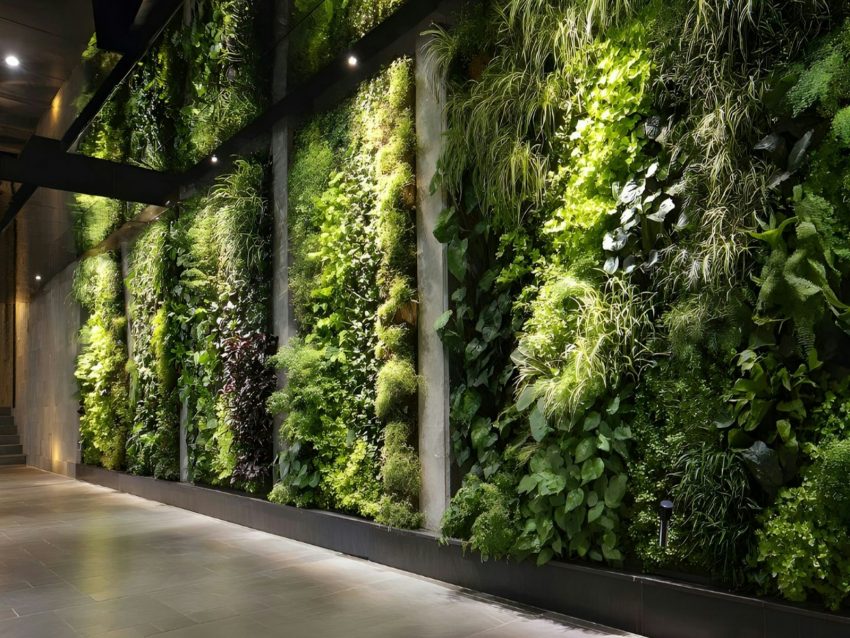
The working assumption behind vertical farming is counterintuitive enough to be worth stating plainly: a balcony of 1.5 square meters, gardened vertically, can outproduce a traditional ground bed of 4-5 square meters for most leafy greens and herbs. The ratio is not magical – it reflects two structural advantages that stack. First, you are using the vertical plane that a ground bed leaves empty. Second, you are usually pairing the vertical structure with either higher-density planting or hydroponic nutrient delivery, both of which accelerate growth independent of space. The combination, in a well-designed system, produces something close to a tripling of yield per floor-area square meter, and this is now well-documented in both research literature and amateur trials.
Why vertical works
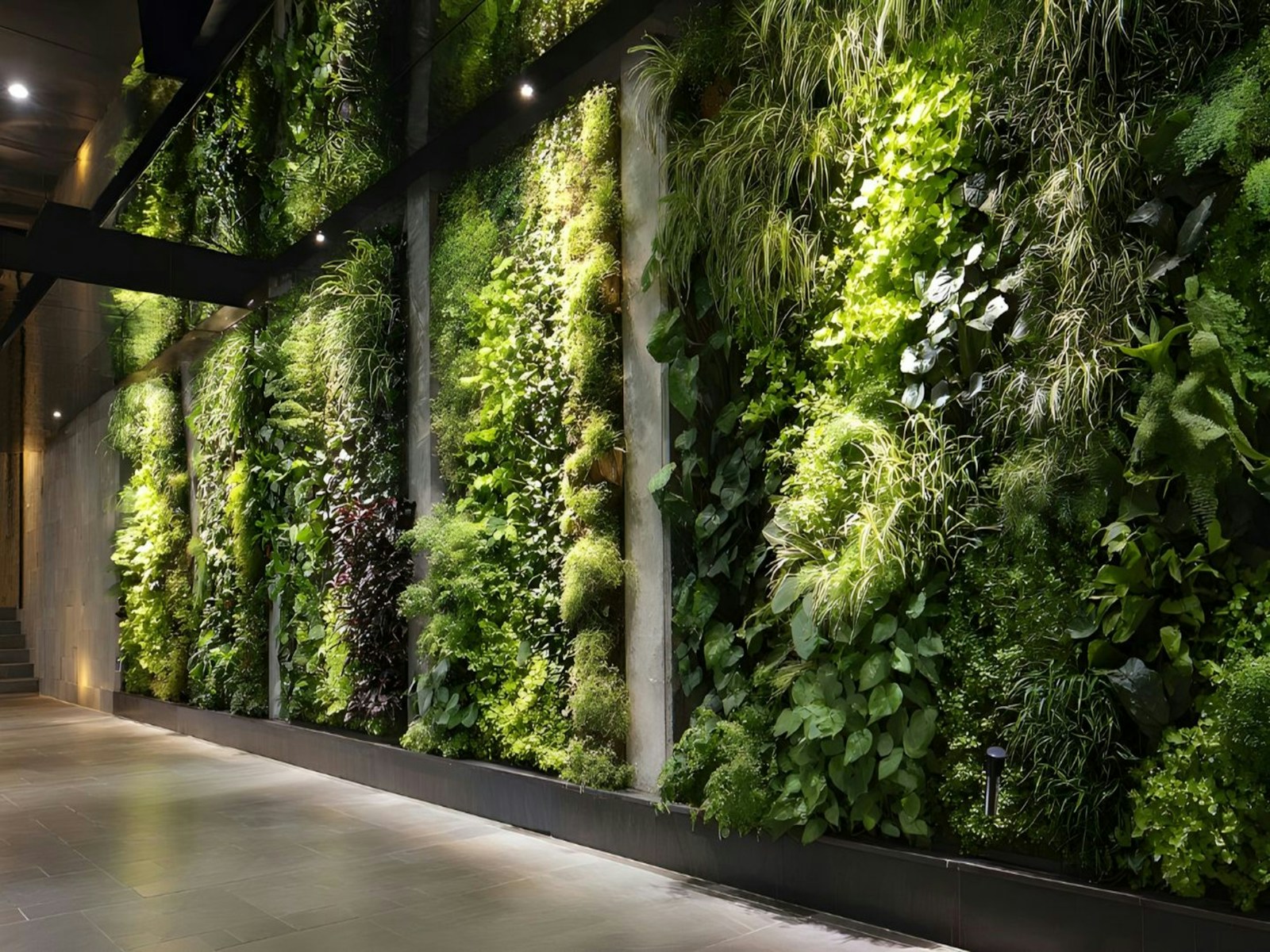
The productivity gain from vertical growing has two components. The first is geometric: on a balcony with a south-facing wall 2 m (6.6 ft) tall, the vertical surface is physically larger than the floor area, and much of it receives comparable light – especially when the wall itself is the structure and plants cluster outward from it. The second is physiological: plants grown with consistent water and nutrient delivery (as in hydroponic tower systems) complete their life cycles faster and produce more biomass per unit of light intercepted than plants in soil with variable watering.
Commercial vertical farms operate in both of these domains simultaneously, which is how warehouses in Newark and Copenhagen manage yields of 250-400 times per square meter relative to field agriculture. A balcony will not reach those numbers because it lacks environmental control and supplemental lighting, but the underlying principles still deliver meaningful multipliers.
The four systems that work at balcony scale
Four basic architectures dominate balcony vertical farming in 2026. They can be combined on a single balcony and often are.
1. Hydroponic tower systems
A vertical hydroponic tower is a column, typically 1.5-2 m (4.9-6.6 ft) tall and 25-40 cm (10-16 in) in diameter, with plant pockets spiraling down its exterior and a water-nutrient solution circulating through its core. Consumer models like the Lettuce Grow Farmstand and the GardenTower (both with European equivalents) cost €400-€900 depending on capacity, while DIY PVC-pipe towers can be built for €60-€180.
Yield numbers from documented builds: a 24-plant tower consistently produces 1.8-2.5 kg (4-5.5 lb) of leafy greens per month during the main growing season, from a floor footprint of roughly 0.15 m² (1.6 sq ft). That works out to something in the range of 13-17 kg (29-37 lb) per m² annually, which is considerably higher than a soil bed of the same area.
Tradeoffs: hydroponic towers require electricity for their circulation pump (20-40 watts, about €5-€10 of electricity per year), and the nutrient solution must be replenished and periodically replaced. They do not work for root crops or most fruiting crops larger than compact cherry tomatoes.
2. Wall-mounted pocket planters
A vertical fabric pocket system mounts directly to a wall and holds soil-grown plants in pocket compartments of 2-4 L (0.5-1 gal) each. Commercial systems cost €30-€120 depending on size; DIY builds from landscape fabric are trivially cheap. Yield per pocket is typical for compact planting – one lettuce or two smaller herbs per pocket – but the vertical surface multiplies the total.
A 1 m × 1.5 m (3.3 × 4.9 ft) wall of pockets with 30 individual pocket slots holds roughly 60 L of growing medium and produces 1.2-2 kg (2.6-4.4 lb) per month of mixed greens and herbs in season. The system is silent, requires no electricity, and tolerates soil-based gardening including compost amendment – it integrates well with apartment permaculture systems.
Tradeoffs: fabric pockets dry out faster than pot culture, so either a drip irrigation system or regular watering is essential. Heavy winds can stress the plants if the wall is exposed.
3. Stacked container towers
A stacked container system uses traditional pots or planters arranged on tiered shelves, in multi-level vertical planters (like the strawberry tower), or on pallet-based vertical structures. Cost varies widely: pallet towers can be effectively free, while engineered tiered planters run €60-€300.
This system has the highest growing-medium volume per unit area, which supports larger plants (small tomato varieties, peppers, strawberries) that pure hydroponic towers cannot accommodate. Yield for a 1 m² (10.7 sq ft) footprint tower with 4 levels: roughly 8-15 kg (17.6-33 lb) per season depending on crop mix. It is the lowest-tech of the four architectures and the most forgiving of inconsistent attention.
Tradeoffs: weight. A fully-loaded container tower can weigh 40-80 kg (88-176 lb), which is within the load limit of most balconies but worth checking against your building’s engineering specification.
4. Trellised climbing crops
The oldest vertical growing system is also still one of the most productive: a trellis or string structure supporting climbing plants – pole beans, cucumbers, indeterminate tomatoes, squash. The floor footprint is a single row of containers, and the vertical yield zone extends as high as you can reach.
A single row of three 20 L (5.3 gal) pots growing indeterminate cherry tomatoes on a 2.5 m (8.2 ft) string trellis can produce 8-12 kg (17.6-26.4 lb) of fruit across a European summer, from a floor footprint of roughly 0.4 m² (4.3 sq ft). Pole beans in the same configuration produce 3-5 kg (6.6-11 lb).
Tradeoffs: trellising requires anchor points, either on the wall, ceiling, or railing, and the crops grown this way are typically single-species per trellis rather than mixed planting.
How the yield multiplier actually works
The « triple yield » figure in the title is neither hyperbole nor guarantee – it is the observed median across documented amateur vertical balcony builds in European urban settings, compared to a conventional single-level container garden of the same floor area. The range across actual builds is roughly 2x to 4x, with the multiplier varying by:
- Crop choice: leafy greens and herbs multiply most; fruiting crops less so because each plant needs substantial photosynthetic surface.
- Light availability: a south-facing wall with 6+ hours of direct sun delivers multipliers toward the top of the range; a shaded wall cannot.
- System type: hydroponic towers push multipliers highest because they add growth-rate acceleration to the geometric advantage.
- Attention: vertical systems require more consistent watering and monitoring than ground beds. Neglected vertical systems drop yield quickly.
A worked example: a 1.4 m² Paris balcony
The following layout is a real working configuration on a south-facing Paris balcony of 1.4 m² (15 sq ft), documented across the 2025 growing season:
- Hydroponic tower (0.15 m² footprint, 20 plant sites): continuous rotation of lettuce, basil, and arugula. Season yield: 11 kg (24 lb).
- Wall pocket system (0.8 m × 1.2 m wall surface, 24 pockets): parsley, thyme, oregano, chives, chard, spinach. Season yield: 4.5 kg (9.9 lb).
- Trellised cherry tomatoes (0.3 m² footprint, 2 plants, 2.2 m string trellis): 7.8 kg (17.2 lb) across July-September.
- Stacked strawberry tower (0.25 m² footprint, 15 plants across 3 levels): 1.8 kg (4 lb) over June-July.
Total seasonal yield from 1.4 m² of floor area: approximately 25 kg (55 lb) of food. A conventional single-level container garden of the same area would typically produce 7-10 kg (15.4-22 lb) across the same period. The multiplier on this specific build landed near 3x, which is consistent with the median for well-designed systems.
Hydroponic systems compared, with real costs
The four-architecture summary above covers the broad categories, but a balcony grower usually chooses between three specific hydroponic methods when building the central growing system: NFT (nutrient film technique), DWC (deep water culture), and the Kratky method. Each has a different relationship with cost, electricity, risk, and crop suitability, and the differences matter enough to treat individually.
NFT (Nutrient Film Technique). NFT runs a thin film of nutrient solution (2 to 3 mm depth) continuously along a gently sloped channel, with plant roots suspended in the flow. A pump in a reservoir at the channel’s low end returns the solution to a holding tank at the high end, and gravity carries it back down. Commercial balcony-scale NFT kits (Nutriculture GT204 or GT214 in the UK and EU markets) cost between 280 and 420 euros and include channels for 12 to 24 plants plus pump and reservoir. DIY NFT systems built from square PVC gutter and a 30-litre reservoir cost 80 to 140 euros in materials. The pump draws about 15 to 25 watts continuously, for roughly 35 to 55 euros of electricity per year at 2026 European rates. Yield for leafy greens at optimal conditions: 2 to 3 kilograms per square metre per month, which is the highest of the three methods. The trade-off is fragility. If the pump fails in hot weather, the film dries within 30 to 90 minutes and plants begin dying irreversibly. A backup pump at 20 euros and a simple float-switch alarm at 15 euros mitigate this but do not eliminate it.
DWC (Deep Water Culture). DWC suspends plant roots in an aerated reservoir of nutrient solution, with an air pump and air stone providing dissolved oxygen continuously. A six-plant DWC bucket system costs 80 to 140 euros commercially, or 40 to 65 euros DIY from 20-litre food-grade buckets. The air pump draws 3 to 8 watts, for about 8 to 18 euros of electricity per year. DWC is the most forgiving hydroponic system: the large volume of water (12 to 18 litres per plant site at maturity) buffers nutrient and pH swings, the roots tolerate brief pump failures because the water itself holds dissolved oxygen for several hours, and topping up the reservoir is the only routine task. Yield per plant matches NFT closely for leafy greens; DWC shines for larger plants like cucumbers, chard, and compact tomatoes because the nutrient volume supports heavier plants than NFT channels can. The trade-off is space: a DWC bucket holds one large plant per 20 litres of water, which is less space-efficient than NFT channels with six to eight plants per metre. Root-rot management (using beneficial Bacillus products or hydrogen peroxide pulses) requires a small learning curve in the first month.
Kratky method. The Kratky method, developed at the University of Hawaii by Bernard Kratky and published in 2009, is a passive hydroponic technique: a plant is suspended above a reservoir with its root tips in the solution, and as the plant drinks down the water level, the exposed air gap grows and provides oxygen to the roots. There is no pump, no electricity, no aeration, and no moving parts. A Kratky system for six lettuce heads costs under 25 euros in materials (six one-litre glass jars with net-pot lids, or a 12-litre plastic tote with net-pot cutouts). Yield for quick-cycle crops (lettuce, basil, bok choy) matches NFT closely across the four to six-week grow cycle, because the plants never exhaust their water or nutrients if the reservoir is sized correctly. The trade-offs are real: Kratky does not work for crops that need more than eight weeks to mature (because the reservoir runs dry or the nutrient balance shifts unacceptably), it does not work for continuous-harvest crops (because the system cannot easily be refilled mid-cycle), and the warm-weather algae growth requires black-painted or foil-wrapped reservoirs. For someone building a first hydroponic system on a balcony without electrical supply — surprisingly common in older European buildings — Kratky is the realistic entry point.
A practical cost-benefit summary for a 2 m² south-facing balcony over 12 months: NFT at 400 euros capital plus 55 euros annual running produces roughly 28 to 36 kilograms of leafy greens. DWC at 130 euros capital plus 18 euros annual running produces roughly 22 to 30 kilograms of mixed greens and chard. Kratky at 25 euros capital plus 15 euros of replaced nutrient per year produces roughly 14 to 20 kilograms of leafy greens. Per kilogram of food produced, Kratky is cheapest by a wide margin; NFT is the highest absolute output; DWC is the middle path and the one most European balcony growers actually adopt after one season of experimentation.
Crop selection for vertical systems, with yield data
Vertical systems are not universally suited to all crops. The fundamental constraint is that the vertical plane favours shallow-rooted plants with light foliage and compact habit; it penalises heavy, deep-rooted, or sprawling plants. The table below summarises documented yield and suitability data from European balcony trials published between 2022 and 2025.
Crops that thrive vertically:
- Strawberries (Fragaria × ananassa). June-bearing varieties (Cambridge Favourite, Honeoye) and day-neutral varieties (Albion, Seascape) both perform well in vertical towers. Yield: 0.8 to 1.4 kg per square metre per month during peak bearing, for a season total of 2.5 to 5 kg per square metre across May to September. The runner habit that ruins strawberries in ground beds works in favour of vertical systems, because runners rooting into adjacent pockets propagate the plantation for free.
- Lettuce and leafy greens. Loose-leaf varieties (Salad Bowl, Lollo Rossa, oak-leaf) outperform heading varieties because cut-and-come-again harvesting extends each plant’s productive window. Yield: 180 to 260 grams per plant site per month in hydroponic systems, 110 to 180 grams in soil-based vertical pockets. Continuous sowing every two weeks maintains year-round production.
- Herbs. Basil, parsley, chives, oregano, thyme, mint, coriander, and chervil all work in vertical systems. Mint particularly benefits from container isolation because its rhizomatous spread is destructive in ground beds. Yield per herb plant is modest (60 to 120 grams per month per established plant) but the aggregate of eight to twelve herb species on a vertical wall covers a two-person household’s culinary needs year-round.
- Compact fruiting plants. Cherry tomatoes (microdwarf varieties like Micro Tom, Red Robin, and Tiny Tim; or dwarf indeterminates like Tumbling Tom) work in hanging pockets. Compact peppers (Apache F1, Redskin, Mohawk) tolerate pocket planters of 4 to 6 litres. Strawberries covered above. Compact cucumbers (Spacemaster, Bush Crop) work in trellised top-rows. Yield for cherry tomatoes in trellised vertical configurations: 2 to 3 kilograms per plant across a European summer.
Crops that do not work vertically:
- Root vegetables. Carrots, parsnips, beetroot, and radishes require 20 to 40 cm of unrestricted downward soil depth. Shallow pocket planters produce misshapen or stunted roots. The one exception is short-rooted varieties of radish (Cherry Belle, French Breakfast), which can tolerate 12 cm containers, but even these suffer relative to ground growing.
- Full-size tomatoes and peppers. Standard-size indeterminate tomatoes (Brandywine, San Marzano) and bell peppers require 25 to 40 litres of root volume and substantial support infrastructure. They can be trellised vertically against a wall if given proper ground-level containers, but they do not work in pocket or tower systems.
- Brassicas in head form. Cauliflower, cabbage, broccoli head varieties need 35 to 50 cm spacing and heavy feeding; a pocket of 3 to 6 litres starves them. Loose-leaf kale (Red Russian, Nero di Toscana) works in larger pockets; heading brassicas do not.
- Vining squash. Pumpkin, winter squash, and watermelon need floor-level sprawl space even when trellised upward; the fruit weight (1.5 to 6 kg per fruit) overwhelms vertical supports.
The yield per square metre of horizontal floor area, comparing vertical optimised planting against conventional container planting across a full European season: strawberries 2.8 versus 0.9 kg per m², lettuce and mixed greens 9.4 versus 3.1 kg per m², herbs 2.6 versus 0.9 kg per m², cherry tomatoes 4.1 versus 2.2 kg per m². The triple-yield claim in the title holds for leafy greens and herbs comfortably; it holds for strawberries and cherry tomatoes at about two-to-threefold; it does not hold for the crops vertical systems cannot accommodate in the first place.
Irrigation: gravity-fed versus pump, and the water economics
Irrigation choice is where balcony vertical farming stops being a weekend hobby and starts being an engineering project. Three irrigation approaches cover most practical setups.
Hand watering. A 5-litre watering can, used twice daily in summer, works for systems of up to roughly 8 to 12 plant sites. Above that scale, the time commitment (15 to 25 minutes twice daily in peak July heat) becomes burdensome, and a single missed day in hot weather damages crops. Water usage: roughly 0.4 to 0.7 litres per plant site per day for soil-based pocket systems in full sun. The practical advantage is that the gardener inspects every plant twice a day, which catches pest and disease problems early.
Gravity-fed drip irrigation. A 40 to 60-litre reservoir mounted above the growing system, with a network of 4 mm or 6 mm drip tubing and pressure-compensating emitters at each plant site, delivers water without a pump. A basic gravity drip kit (Rain Bird GravityLine or DripWorks GravityFed, plus European equivalents from Gardena and Hozelock) costs 60 to 130 euros. Flow rates are typically 1 to 2 litres per hour per emitter, which means a 20-emitter system delivers 20 to 40 litres per hour when the reservoir valve opens. A simple timer valve at 35 euros runs the system for predictable intervals; a battery-powered digital timer at 55 to 80 euros offers multiple daily cycles. Water usage: 25 to 40 percent less than hand watering, because the slow drip application avoids the surface runoff that occurs when watering cans dump water faster than soil can absorb. No electricity required.
Pump-driven drip and hydroponic recirculation. A 12-volt or mains-powered pump paired with a reservoir and distribution manifold supports larger and more complex systems. A complete balcony irrigation kit with pump, timer, 25-metre drip tubing, and pressure-compensating emitters costs 110 to 220 euros. The pump runs 8 to 25 watts during its cycles, for 5 to 12 euros of electricity per year. Hydroponic recirculating systems (NFT and DWC covered above) integrate their irrigation with the main growing system, which is one of the reasons serious balcony growers often converge on hydroponic architectures: the irrigation problem is solved inside the growing-system purchase. Water usage in closed recirculating systems: 85 to 92 percent less than soil-based hand watering, because the same water passes the roots multiple times before evaporating.
For the water-economics comparison across a full European growing season, a 2 m² balcony producing roughly 25 kg of food uses: hand-watered soil containers around 1,200 to 1,600 litres per season; gravity-fed drip irrigation on soil containers around 800 to 1,100 litres per season; recirculating hydroponic systems around 150 to 220 litres per season. A traditional ground garden producing the same 25 kg of food across open soil typically uses 1,800 to 2,500 litres per season because of evaporation losses in uncovered beds. Vertical farming, particularly when paired with hydroponic recirculation, is the most water-efficient food production method available to a balcony grower by a wide margin, and it is roughly five to ten times more water-efficient than conventional field agriculture producing the same output.
The timer controllers worth mentioning specifically: the Gardena MultiControl Duo (around 85 euros) supports two separate zones on independent schedules, which is useful when leafy greens in one zone need more frequent shorter cycles than fruiting crops in another. The Melnor HydroLogic (around 55 euros) is the budget reliable choice. The Rachio Smart Controller and its European equivalents (120 to 180 euros) connect to weather forecasts and skip scheduled waterings on rainy days; on a balcony the feature matters less than it does for open gardens, but the granular scheduling is genuinely useful.
Light, the constraint that cannot be engineered around
No vertical system rescues a balcony that does not receive enough light. Leafy greens need 4+ hours of direct light or 6+ hours of bright indirect light daily. Fruiting crops need 6+ hours of direct light. A north-facing balcony in Paris in April gets neither, regardless of how cleverly you design the growing structure.
The honest assessment is that vertical systems multiply the output of a light-sufficient balcony but do not create productivity where light is not available. For shaded balconies, the realistic options are either shade-tolerant crops (mint, some lettuces, chervil, sorrel) at reduced expectation, or supplemental LED grow lighting (which adds €40-€200 of initial cost and €15-€60 per year of electricity).
Seasonal rotation for a productive balcony
A vertical balcony productive through the full European growing season requires deliberate seasonal rotation rather than setting up once and hoping. A reasonable seasonal pattern:
- March-April: peas, spring greens, radishes, early lettuce in pocket system; seedlings starting.
- May-June: transition to summer crops; tomatoes and peppers go into trellised positions; strawberries come into production.
- July-August: peak production; continuous sowing of lettuce in tower; herbs at maximum.
- September-October: second planting of cool-season crops; last tomato harvests; autumn lettuce and chard.
- November-February: hardy greens only outdoors (winter lettuce, mache, hardy kale) unless supplemental light is available.
Costs, honestly
A complete vertical balcony setup costs €100-€500 depending on whether you favor DIY or purchased systems. Roughly:
- Hydroponic tower (DIY or used): €60-€150
- Hydroponic tower (commercial): €350-€900
- Wall pocket system: €30-€120
- Trellis hardware: €15-€40
- Container stack structures: €20-€250
- Initial soil, seeds, nutrients: €30-€80
Annual running cost for a productive balcony vertical farm: €30-€100 covering seeds, seasonal soil amendment, nutrient solution, and electricity. Food produced, valued at market rates, typically €200-€450 per season. The economics are positive but are not the strongest argument for the practice.
Common mistakes in the first season
Three errors account for most first-season disappointment. First, watering frequency: vertical systems dry out faster than ground systems, and irregular watering hits vertical crops harder. A simple gravity-fed drip schedule solves this. Second, over-planting at the start, before you know what actually thrives in your specific microclimate; a new vertical farmer should plant at 70% capacity in year one and calibrate. Third, ignoring wind: balconies above the third or fourth floor experience wind patterns that can shred tender leafy greens; windbreaks (a simple mesh screen, €15) make the difference between a system that works and one that does not.
For further reading
For the research context on vertical farming productivity, Nature Food has published regularly on the topic, and BBC Future maintains an accessible archive on urban agriculture. Coverage in The Guardian‘s environment section tracks the policy and ecological side.
For related pieces on balcony infrastructure, see our companion articles on apartment permaculture and on rainwater harvesting for urban gardens, both of which integrate naturally with vertical growing systems.
A final thought
Vertical farming on a balcony is not a hobby that scales to feeding a family, but it is a hobby that reconfigures your sense of how much food a small space can hold. The first summer harvest from a well-designed vertical balcony – a bowl of tomatoes from a trellis that was an empty wall in April, a continuous supply of lettuce from a tower that occupies less floor than a chair – is memorable in a way that store-bought vegetables are not. The productivity multipliers are real. The pleasure of the output is the reason most vertical balcony gardeners stay at it.