
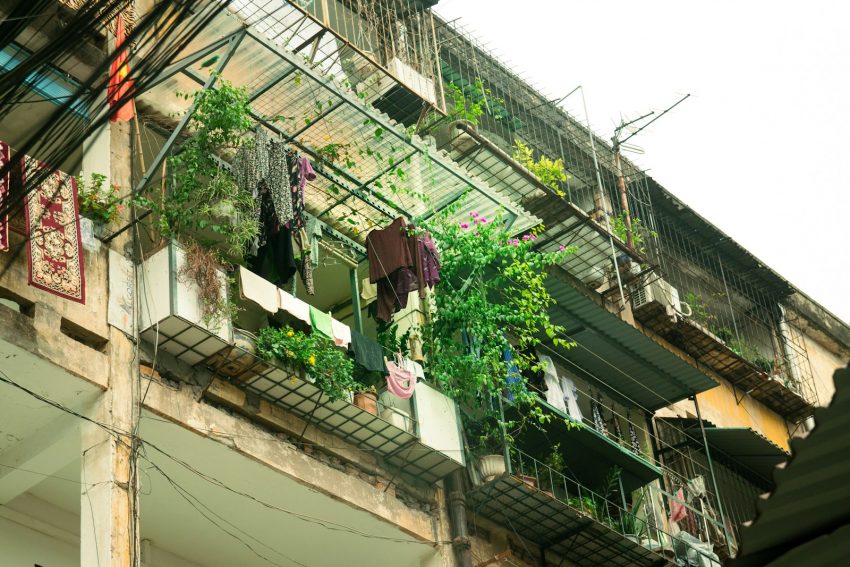
The first balcony I gardened, in a north-facing fourth-floor flat in Lyon, received approximately ninety minutes of direct sun in midsummer and zero hours from October through April. The standard advice — tomatoes, basil, peppers, sun-loving Mediterranean herbs — was useless to me. After two failed seasons of trying to grow what gardening books told me to grow, I started over with the plants that actually evolved in shaded forest understorey: ferns, hostas, woodland geraniums, certain salad greens, and a small group of edible roots that flower briefly under tree canopy in spring. The shaded balcony was not a problem to solve. It was a different microclimate that required different plants.
This guide covers what actually grows reliably on shaded urban balconies, how to read the light situation honestly before buying anything, what watering and soil practices differ from sun-balcony gardening, and how to design a small space that produces both food and beauty without the standard sun-loving plant list.
Reading your balcony’s actual light
Most shade-balcony failures come from misreading the light situation. The best diagnostic is the simplest: spend a full sunny day at home and check the balcony every hour, noting whether direct sun reaches each section. The result will usually surprise you. North-facing balconies in northern Europe receive almost no direct sun. North-facing balconies in southern Italy receive several hours in summer, particularly early morning. East-facing balconies get sun before noon and shade afterward; west-facing balconies receive afternoon sun, which is hotter than the morning equivalent.
The result is that « shade » can mean very different conditions. A north-facing Lyon balcony at 45 degrees latitude is meaningfully different from a north-facing Naples balcony at 41 degrees, and both differ from a balcony shadowed by a taller building rather than by orientation alone. Plants suited to one are often unsuited to the others. A useful classification:
- Deep shade: less than 1 hour of direct sun, including indirect. Forest-understorey plants only.
- Light shade: 1-3 hours direct sun, mostly morning. Most shade-tolerant plants thrive here.
- Dappled shade: filtered sun through tree canopy. Surprisingly versatile; supports many salad greens.
- Bright shade: no direct sun but open sky overhead. The most plant-friendly shade condition.
The plants that actually work
Across multiple seasons of shaded-balcony work, the following plants have been the most reliable in my own gardening and in the experience of shade-balcony gardeners I have interviewed across France, Italy and Belgium.
Ornamental shade plants
Ferns are the foundation of any serious shade balcony. The most balcony-suitable species are Polystichum setiferum (the soft shield fern, evergreen in mild climates), Asplenium scolopendrium (hart’s tongue fern, glossy and architectural), and Athyrium niponicum ‘Pictum’ (Japanese painted fern, with silver and burgundy markings). Most ferns require consistently moist soil and will brown rapidly if allowed to dry out.
Hostas are the second pillar. Hostas come in dozens of cultivars from miniature (10 cm) to enormous (120 cm spread). For balconies, the smaller cultivars — Hosta ‘Blue Mouse Ears’, ‘Mighty Mouse’, ‘Wheee!’ — are most practical. Hostas die back completely in winter and re-emerge in spring; some balcony gardeners find this disorienting at first.
Heucheras (coral bells) provide year-round colour through a wide range of leaf colours from lime green to near-black. They are evergreen in mild climates and tolerate shade better than most flowering perennials.
Astilbe produces feathery flower spikes in early summer in pink, white or red, and tolerates surprisingly deep shade. The plants need consistent moisture and will not flower if soil dries out repeatedly.
Begonias, particularly the Rex and tuberous types, flower well in shade and recover quickly from drought stress.
Edible plants for shade
The myth that shade balconies cannot grow food is exactly that. Several food crops grow as well or better in shade than in sun, particularly in summer when sun-grown lettuces bolt rapidly.
- Salad greens: lettuce, mizuna, mustard greens, mâche (lamb’s lettuce), arugula, sorrel — all benefit from shade in summer.
- Herbs that prefer shade: parsley, chives, chervil, mint (in containment, since it spreads), tarragon, coriander (which bolts in heat).
- Asian greens: bok choy, tatsoi, komatsuna — all grow in cool shade.
- Wild garlic (Allium ursinum): a forest-floor plant that grows brilliantly in deep shade, dies back by midsummer.
- Strawberries: alpine strawberries (Fragaria vesca) tolerate shade better than commercial cultivars and produce small but flavorful fruit through summer.
Soil and watering for shade balconies
Shade balcony soil should be richer in organic matter than typical container mix, since shade-loving plants are evolved for forest-floor conditions. A good mix is roughly 60 percent quality container compost, 25 percent garden compost or well-rotted leaf mould, and 15 percent perlite or fine grit for drainage. Avoid the sandy, fast-draining mixes sold for Mediterranean herb gardens; shade plants will dry out and brown.
Watering is the most consistent failure mode. Counterintuitively, shaded containers can dry out as quickly as sun-facing ones, because shade-loving plants typically have larger leaves with higher transpiration rates. The shade does, however, slow evaporation from the soil surface, which means the watering pattern is different: shaded containers should be checked daily but watered less aggressively when watered. Stick a finger 5 cm into the soil; water when it feels dry, ignore the surface.

Design principles for small shaded balconies
Designing a shaded balcony requires different thinking than sun-balcony design. Several practical principles emerge from watching what works.
Use foliage rather than flowers
Shade plants flower less reliably than sun plants, and the flowering windows are usually shorter. Designing for foliage colour and texture rather than flowers produces a balcony that looks intentional all year, rather than briefly spectacular and then bare. The hosta-fern-heuchera combination, varied across multiple cultivars, can sustain visual interest from March through November.
Layer heights
Shaded balconies feel claustrophobic when all plants are at the same height. Use trailing plants (creeping Jenny, ivy, ferns spilling over containers) at the lowest level, mid-height architectural plants (hostas, ferns, astilbe) in the middle, and one or two upright accents (a small shade tolerant tree like a Japanese maple in a large container, if space allows).
Use light containers
Dark containers absorb heat from the small amount of sun a shaded balcony receives, which can stress shade-adapted roots. Light-coloured terracotta, glazed white or pale grey ceramics, or pale wood are all preferable to black plastic.
Build moisture sinks
A shallow water tray with pebbles under several containers raises local humidity and reduces leaf-edge browning on ferns and hostas. Several shade-balcony gardeners have reported that this single intervention transforms plant health.
Seasonal rhythm of a shade balcony
Shade balconies follow a different annual rhythm from sun balconies. Spring is the most dramatic season: deciduous shade plants emerge rapidly, ferns unfurl, hostas push through soil. Summer is the steady-state period, with consistent foliage colour. Autumn produces a quieter version of the woodland colour change, with hostas turning yellow and dying back, while heucheras intensify their winter colours. Winter on a shade balcony is usually quieter than on a sun balcony, with evergreen ferns, ivy and heucheras providing the structural interest.
This rhythm matters for planning. Buy bulbs in early autumn for spring colour (snowdrops, miniature daffodils, scilla — all woodland-floor plants that flower before tree leaves emerge in nature, which translates well to shade balconies). Buy ferns and hostas in spring when their condition is visible. Buy heucheras and other evergreens in autumn when nurseries have stocked their winter colour.
Common shade balcony mistakes
Several recurring mistakes come up often enough to flag explicitly:
- Buying sun plants and hoping they adapt. They do not. A tomato in shade will produce stems and leaves but no fruit.
- Overwatering in winter. Shade balconies in winter receive little evaporative drying, and constant wet soil can rot dormant root systems.
- Overcrowding. Shade plants need more air circulation than sun plants because shaded balconies are inherently more humid; powdery mildew develops quickly in dense plantings.
- Using fast-draining « Mediterranean » potting mix. The mix is wrong for shade plants and will dry out the roots within hours.
- Expecting flowers to be the visual centrepiece. Plan around foliage instead.
What an established shade balcony looks like after three years
The shade balcony I have maintained longest, in a north-facing flat in Brussels, contains by year three about thirty plants in twelve containers. The balcony measures roughly two metres by one metre. The dominant plants are four hostas, two large ferns, a heuchera collection of five varieties, three small Japanese painted ferns, an astilbe, an ivy that trails along the railing, a small Acer palmatum in a 30 cm pot, and seasonal herbs in smaller pots. The balcony produces enough parsley, chives, mint and salad greens to substantially supplement summer cooking. The flowering moments come briefly in May (astilbe, heuchera spikes) and in autumn (when several plants produce a second flowering), with foliage carrying the rest of the year.
The balcony has required, on average, fifteen minutes of attention per day during the growing season and a brief check perhaps weekly in winter. The financial investment, accumulated across three years, has been roughly four hundred euros, with the larger pots and the Acer accounting for most of that. The pleasure-per-euro ratio has been favourable.
Regional variations: how shade balconies differ across Europe
Shade balcony gardening differs substantially across European climates, and the standard plant lists need adjustment by region. In northern France, the Low Countries and the British Isles, the standard hosta-fern-heuchera palette translates almost directly. The relatively cool summers and reliable rainfall mean that shade plants from the temperate woodland flora of Europe and North America thrive without unusual interventions.
In southern Europe, the picture changes. Shade in Naples, Seville or Athens is genuinely useful for plants that would burn in full sun, but the shade balconies of southern Italy, Spain and Greece still receive substantial heat in midsummer. Plants suited to deep British shade may struggle in southern shade because the ambient air temperature exceeds their tolerance even when direct sun is absent. The practical adjustment is to lean on Mediterranean shade plants — bay laurel, rosemary in a partly shaded position, oregano, certain edible vines — and to add a small group of subtropical understorey plants from the Mediterranean’s own native flora.
In central and eastern European climates with severe winters, the practical question shifts to overwintering. Hostas, astilbe and most ferns are reliably hardy through Zone 5 winters, but some heucheras struggle below minus fifteen degrees Celsius without protection. Many container plants benefit from being moved to an unheated garage, balcony enclosure or basement during the coldest weeks. The Polish and Czech container-gardening traditions have well-developed conventions for winter container protection that translate usefully to shaded balconies in similar climates.
The microclimate of an apartment balcony
Apartment balconies, including shaded ones, have microclimates that differ meaningfully from open-ground gardens. The most consistent difference is wind exposure. Even in apparently sheltered urban locations, balconies experience wind funnelling around buildings that can desiccate plants more quickly than equivalent ground-level positions. The practical implication is that watering frequency on a balcony often exceeds what would be required for the same plants in a courtyard at ground level, even when light conditions appear similar.
The second microclimate factor is reflected and radiated heat from surrounding buildings. A north-facing balcony with white-painted walls reflecting back into the space receives more total light than an equivalent balcony with dark stone walls. The reflected light is mostly diffuse and useful for shade plants. The thermal contribution is more variable; light walls can keep summer temperatures more moderate, while dark walls may push summer balcony temperatures above what shade plants tolerate.
The third factor is the rain shadow created by overhanging balconies, awnings and projecting building features. Many « shaded » balconies receive substantially less natural rainfall than the surrounding street level, which means that even rain-tolerant plants may need supplemental watering during what appears to be wet weather. Several balcony gardeners I have spoken to in Lyon, Berlin and Rotterdam have been surprised to find their plants suffering drought stress during apparently rainy weeks because the rain never actually reached the containers.
Misconceptions about shade gardening
Several common misconceptions about shade gardening deserve correction. The first is that shade plants do not need fertiliser. They do, particularly in containers where the available nutrient pool is limited by container volume. Most shade plants benefit from a slow-release organic fertiliser applied in early spring and a liquid feed once or twice during peak growing season. The fertiliser requirement is more modest than for fruiting sun plants, but it is not zero.
The second misconception is that shade plants are inherently slow-growing. Some are; many are not. Hostas in particular grow rapidly when given good soil and consistent moisture, and several established hosta cultivars will fill a 30 cm container in two seasons. Ferns vary widely; the soft shield fern grows quickly while the hart’s tongue fern is more deliberate. Plant choice within shade categories matters as much as choice between sun and shade categories.
The third is that shaded balconies are easier to maintain than sunny ones. They are different rather than easier. Shaded balconies have lower water demand on hot days but higher year-round humidity, which means fungal issues (powdery mildew, leaf spot, slug damage on hostas) require more attention. Sunny balconies have higher water demand but generally fewer fungal pressures.
The fourth is that shade balconies cannot support pollinators. They can, in modest ways. Native woodland plants — wild geranium, foamflower, columbine, certain native asters — attract bumblebees and the smaller solitary bees that operate well in low light. The pollinator support is less abundant than from a sun-facing wildflower terrace, but it is meaningful, particularly given the broader collapse of urban pollinator habitat documented by the European Bee Initiative since 2018.
Implementation: a 12-month timeline for a new shade balcony
For readers starting a shade balcony from scratch, the timeline below has worked across most of the new shade gardeners I have advised. Total spend across the year typically runs 200 to 500 euros depending on container choices.
- March: light audit. Spend a sunny day at home charting the balcony’s light pattern hour by hour. Note total direct-sun hours, and when they fall.
- March to April: foundational containers. Buy three to five 25 to 35 cm light-coloured pots, container compost rich in organic matter, and a shade-tolerant container collection: one large hosta, two ferns, two heucheras.
- May: edible additions. Add small pots of parsley, chives and mint (in a self-contained pot, since mint spreads aggressively).
- June to August: observation phase. Watch what thrives, what struggles, where the wind hits hardest. Make small adjustments rather than buying more plants.
- September: spring bulbs. Plant snowdrops, scilla and miniature daffodils in the foundational containers for early spring colour.
- October to February: structural plants. Add evergreen ferns, ivy and a small Japanese maple if space and budget allow. Prepare winter protection for any marginal plants.
- March (year two): expansion. By this point you understand which positions on your balcony reliably grow what, and you can expand confidently. Buy what worked in year one rather than experimenting widely.
Further reading
The Wikipedia entry on container gardening provides general principles. The Royal Horticultural Society publishes detailed shade-plant guidance. The Royal Botanic Gardens, Kew publishes substantial scientific literature on shade-tolerant species and their light requirements, useful for readers who want primary sources behind plant recommendations. Our archive on urban food growing is at potagers en ville, with broader plant material at plantes & saisons, and a separate thread on urban gardening covering balcony and terrace design.
This article is for informational purposes and reflects personal balcony gardening across multiple climates; specific plant suitability varies by region and microclimate, so consult local nurseries for the most reliable advice for your area.